
Quick answer: A conventional transparent LED display, a holographic-style LED screen and LED film are different construction directions for a glass or open-space project. Choose by the actual glass or support structure, the side from which people will watch, daylight, visible hardware, cable routes and service access. Do not use one product family’s transparency percentage or module dimensions as a specification for the others.
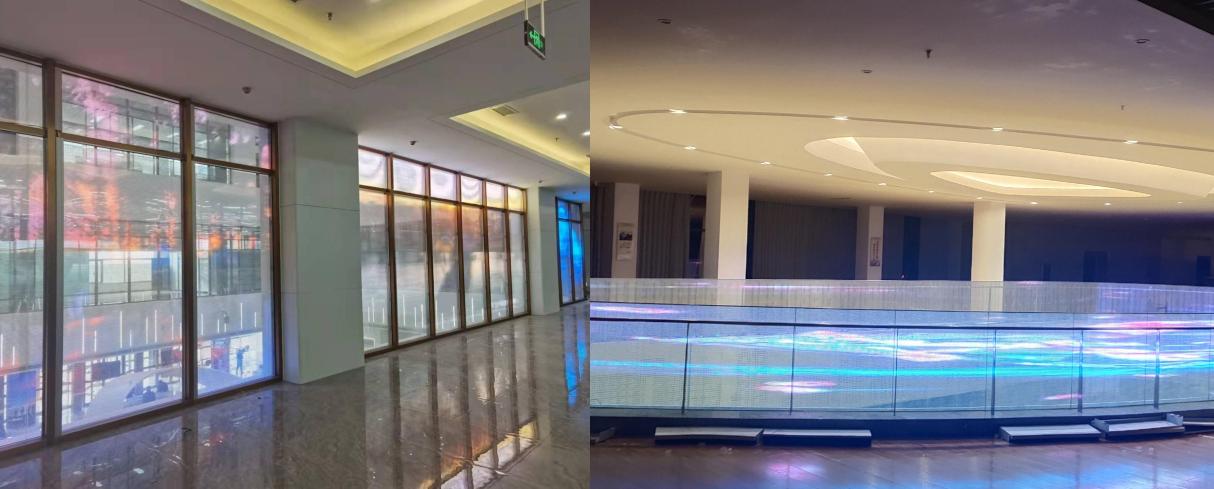
How do the three display directions differ?
| Direction | Starting point for planning | Details to confirm |
|---|---|---|
| Conventional transparent LED display | A cabinet, grille or bar structure that can be supported independently or integrated with architecture | Frame depth, fixing, visible bars, service side and sightlines |
| Holographic-style LED screen | A see-through LED product series selected for its particular module geometry and visual effect | Exact series, viewing direction, support, module seams and catalog data |
| LED film format | A film-format display considered for a suitable glass surface | Glass condition, approved attachment method, power edge, cable routing and replacement method |
These are planning categories, not interchangeable construction specifications. “Holographic” is a product description used in the supplied catalog; it should not be read as a promise of a free-standing optical hologram. A design may also combine transparent display elements with separate supporting structure. Ask the supplier to show the actual construction drawing for the proposed model.
Read transparency figures within the named product series
The supplied Xuancai holographic-display catalog lists the following selected GX PH models. The figures describe that catalog series only. They do not specify the transparency, installed visibility or glass suitability of a conventional transparent cabinet or an LED film product.
| Catalog model | Pixel pitch | Listed module size | Catalog transparency | Listed refresh rate |
|---|---|---|---|---|
| GX PH2.5 | 2.5 mm | 1500 × 160 mm | 70% | ≥3,840 Hz |
| GX PH3.91 | 3.91 mm | 1500 × 250 mm | 85% | ≥3,840 Hz |
| GX PH7.82 | 7.82 mm | 1500 × 250 mm | 95% | ≥3,840 Hz |
Source: Xuancai holographic-display catalog (炫彩显示画册), PDF p. 15, supplied as company-group product material. These are catalog references for the listed GX PH series, not verified values for every transparent display or installed project. Confirm the current model sheet, test method, mounting arrangement and service scope before ordering. The transparent, holographic and LED film product page has the wider series table and source note.
Six questions to resolve before a glass-display quotation
1. Where will viewers stand?
Mark whether the main audience is outside the window, inside the building or on both sides. Note the closest viewing position, normal walking route and any periods of direct sun or night-time reflection. A display that looks clear in one photograph can appear different against a real interior and changing daylight.
2. What are the glass and frame dimensions?
Send elevations, pane widths and heights, mullion locations, opening details and available fixing points. State whether the glass can accept any attachment and who must approve it. A catalog module dimension does not prove that the finished installation fits a particular pane or meets its structural requirements.
3. How much of the view must remain open?
Explain what must remain visible through the façade or partition. Compare the proposed hardware and a sample content scene against the actual background. The catalog transparency percentage is one reference; perceived transparency also changes with content, lighting, structure and viewing angle.
4. Where can power and cables go?
Identify the power position, cable path and places where equipment can be concealed without obstructing doors, access or glazing maintenance. Ask for a drawing showing the power edge, control equipment and all visible connections for the selected display format.
5. How will the display be serviced?
Confirm the reachable side for inspection, cleaning and replacement. For a glass-side film format, ask how a damaged section would be removed and replaced. For a framed or modular display, confirm access around the cabinet or module edges. Plan these details before surrounding finishes are fixed.
6. What content will be shown?
Share sample graphics, desired reading distance and operating hours. Text-heavy layouts, bright solid backgrounds and sparse motion use the transparent area differently. Ask for a content mock-up using the proposed pixel canvas and view it from the normal audience positions. A screen demonstration should represent the planned environment as closely as practical.
Common buyer questions
Can LED film be attached to any glass?
No general answer follows from the word “film.” The exact product’s attachment method, glass condition, dimensions, edge details and maintenance route need approval for the site. Obtain the selected model’s installation requirements before treating a pane as suitable.
Does a higher catalog transparency number always look better?
Not by itself. The required content detail, viewing distance, background and lighting also matter. Compare samples from the product series being quoted, and avoid comparing percentages from unrelated formats without the measurement method.
What should be included in the first project brief?
Send glass elevations and photographs, viewing sides, daylight conditions, desired display area, content examples, power and cable constraints, fixing restrictions, destination and schedule. For retail uses, the retail LED display guide adds audience and storefront planning points.
Share your glass layout for a transparent LED display review.